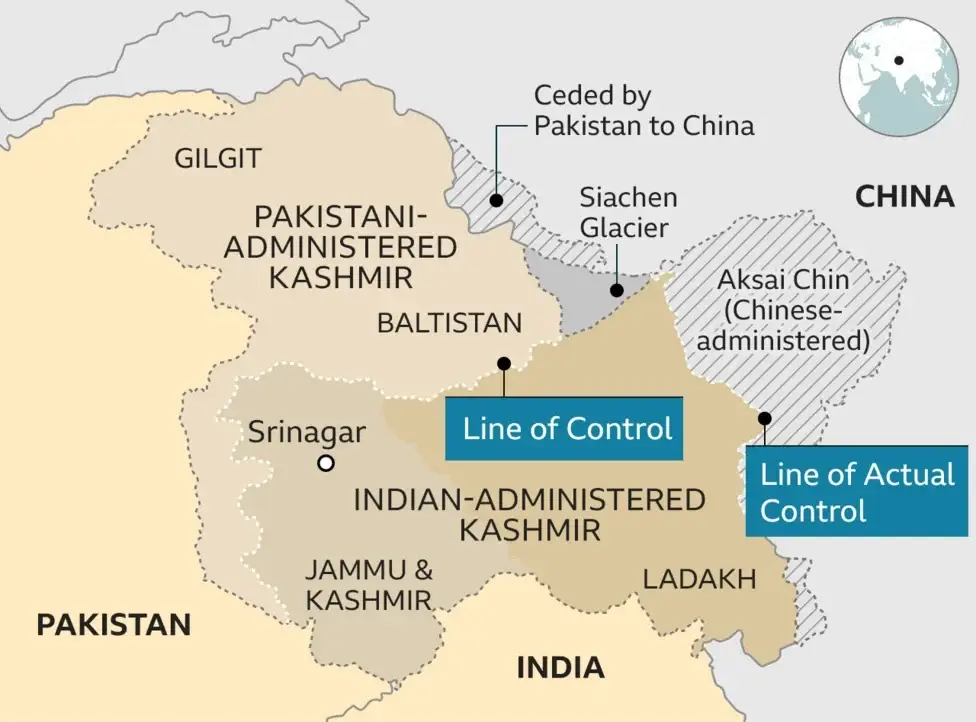
Kashmir Map

5,000 Years of History

KashmirHistory

A land of extraordinary civilization — Hinduism, Buddhism, Islam, Sufism — and a people whose right to determine their own future has been denied since 1947.

Pakistan Administered
Azad Kashmir
13,297 km²
Pakistan Administered
Gilgit-Baltistan
72,496 km²
India Administered
Jammu & Kashmir + Ladakh
114,684 km²
China Administered
Aksai Chin + Shaksgam
~43,000 km²

Introduction

About
Kashmir

Kashmir, with a history spanning over 5,000 years, has been a centre of Hinduism, Buddhism, and later Islam and Sufism. It was ruled by various dynasties, including the Mauryas, Kushans, and Karkotas, before Shah Mir established Muslim rule in the 14th century.

Foreign powers significantly influenced its fate — the Mughals annexing it in 1586, followed by Afghan and Sikh rule. In 1846, the British took control after the First Anglo-Sikh War, selling it to Maharaja Gulab Singh under the Treaty of Amritsar, setting the stage for future political conflicts.

Often referred to as 'Paradise on Earth,' Kashmir covers a total area of approximately 222,236 square kilometres and is currently administered by India, Pakistan, and China — a division that remains contested and unresolved.

Following the abrogation of Articles 370 and 35A on 5th August 2019, Indian Administered Jammu and Kashmir lost its special status and was reorganised into two union territories under direct Indian control.

Kashmir Map — Lines of Control
Kashmir · Lines of Control · Current Administrative Divisions

Total Area

222,236
sq km · Combined Kashmir Region
85,793
Pakistan Admin.
~114K
India Admin.
37,555
China Admin.
14M+
Total People

Political Evolution

Historical
Developments

1846–1947 · Colonial & Dogra Period
1846
Treaty of Amritsar
Signed between the British East India Company and Maharaja Gulab Singh, transferring Jammu and Kashmir to Dogra rule in exchange for payment. Laid the foundation for modern political control over the region.
1931
Civil Unrest — 22 Killed
Widespread protests against Maharaja Hari Singh's rule led to the killing of 22 protesters on 13 July 1931. This pivotal event ignited organized resistance and long-term political movements in Kashmir.
1932
J&K Muslim Conference Founded
Formed to represent the political, social, and economic interests of Kashmir's Muslim majority — in response to widespread grievances under Dogra rule.
1939
Rebranded as National Conference
The Muslim Conference was rebranded to broaden its political base beyond religious identity, uniting diverse communities under a platform for democratic rights and social reform.
1947
Indian Independence Act
Princely states could join India, Pakistan, or remain independent. Maharaja Hari Singh initially sought independence for Jammu and Kashmir — creating the fateful ambiguity that endures to this day.
1947–2019 · Conflict & Occupation
4 Oct 1947
Provisional Government of AK
Rebels and political leaders formed a provisional government for Azad Kashmir, seeking an independent administration apart from Maharaja Hari Singh's rule.
22 Oct 1947
Invasion by Tribal Forces
Tribal forces supported by Pakistan's government invaded Jammu and Kashmir. The attack led to widespread violence, forcing Maharaja Hari Singh to seek military assistance from India.
26 Oct 1947
Instrument of Accession
Maharaja Hari Singh signed the Instrument of Accession. Lord Mountbatten accepted it conditionally — pending a plebiscite once order was restored. That plebiscite was never held. The UN never recognised the accession as final.
1 Jan 1948
India Takes Issue to UN
India formally brought the Kashmir dispute to the United Nations Security Council, placing it on the international stage — where it remains unresolved.
5 Aug 2019
Abrogation of Article 370
India abrogated Articles 370 and 35A, stripping Indian-administered Jammu and Kashmir of its special status and bifurcating it into two Union Territories under direct central control — condemned by Kashmiris and Pakistan as illegal and unilateral.

International Forums

United Nations
Resolutions

The United Nations Security Council has passed numerous resolutions on Kashmir — all calling for a plebiscite that India has never permitted.

Res. 38
17 January 1948
Called for India and Pakistan to refrain from any action that might aggravate the situation in Kashmir.
Res. 39
20 January 1948
Established the United Nations Commission for India and Pakistan (UNCIP) to investigate the conflict.
Res. 47
21 April 1948
Called for a ceasefire, withdrawal of troops, and a plebiscite to determine Kashmir's future — the most significant UN resolution on Kashmir.
Res. 80
14 March 1950
Urged both nations to implement demilitarisation measures as a precondition for the plebiscite.
Res. 91
30 March 1951
Declared that the Constituent Assembly of Jammu and Kashmir could not determine the region's final status.
Res. 122
24 January 1957
Declared that any unilateral decision on Kashmir's status — including by India — was invalid under international law.
Res. 123
21 February 1957
Called for continued UN mediation to resolve the dispute through an impartial, democratic process.
Res. 96
10 November 1951
Reaffirmed the need for a United Nations-supervised plebiscite to determine the wishes of the Kashmiri people.
Res. 126
2 December 1957
Reaffirmed all previous resolutions and the necessity of an impartial plebiscite — still awaiting implementation.

Human Rights

International
Human Rights
Reports

Documented Violations
Amnesty International and Human Rights Watch have consistently reported on enforced disappearances, arbitrary arrests, and torture of detainees in both Indian and Pakistan administered Kashmir.
The UN Human Rights Office released reports in 2018 and 2019 highlighting mass human rights violations — including extrajudicial killings, suppression of dissent, and media censorship.
Thousands of Kashmiris have been detained under preventive detention laws, many held without trial for extended periods.
According to various independent estimates, tens of thousands of people have been killed in the Kashmir conflict since 1989, with an overwhelming number being civilians.
Surveys on Public Opinion
In 1947, there were calls for an independent Kashmir, but the geopolitical conflict between India and Pakistan overshadowed this demand entirely.
A 1950s UN survey emphasized the need for a plebiscite — but it was never conducted due to political tensions between the two nuclear powers.
A 1995 International Crisis Group survey suggested a significant portion of the Kashmiri population desired independence rather than integration with either India or Pakistan.
A 2010 Chatham House survey indicated that a large percentage of people in Jammu and Kashmir supported independence or greater autonomy from both countries.
"Kashmir, often referred to as Paradise on Earth, remains the world's most militarized zone — a paradise denied its freedom since 1947."
Kashmir Freedom Movement · Historical Archive